Biology has a language problem. Not the kind where your doctor uses words you need to Google afterward - though that too - but a deeper one. The "code" running inside every cell on Earth is written in a four-letter alphabet (A, T, G, C), gets transcribed into RNA, translated into proteins, and somehow produces... you. The whole pipeline makes enterprise software architecture look like a shopping list. And now, a team from Harvard, Stanford, Arc Institute, and Scripps Research says AI is finally getting fluent enough to read - and maybe even edit - the whole thing at once.
Their review, published in Nature Biotechnology in March 2026, introduces the concept of Generalist Biological AI (GBAI): systems that don't just analyze one type of biological molecule, but process DNA, RNA, proteins, and entire cellular systems simultaneously (Rao et al., 2026). Think of it as the difference between an AI that only speaks French and one that's fluent in French, Mandarin, Arabic, and also reads sheet music.
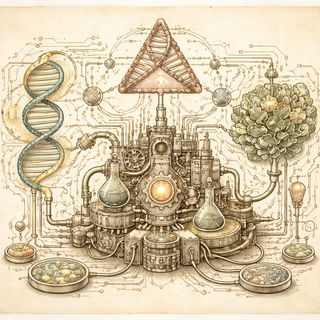
One Model to Rule Them All (Molecules)
Until recently, biological AI was a collection of specialists. AlphaFold cracked protein folding and won a Nobel Prize for it (Jumper et al., 2021). Meta's ESM-2 learned to predict protein structure from sequence alone, building an atlas of 772 million predicted structures faster than you can say "metagenomics" (Lin et al., 2023). DNA had its own models. RNA had its own models. Everyone stayed in their lane.
But biology doesn't work in lanes. DNA encodes RNA, RNA makes proteins, proteins do basically everything else. A model that only speaks "protein" is like translating a novel by reading every third chapter.
Enter the generalists. Evo 2, a 40-billion-parameter model from Arc Institute, trained on 9 trillion DNA base pairs from across all domains of life, can predict disease-causing mutations, design functional gene sequences, and even draft genomes the length of simple bacteria - all without task-specific fine-tuning (Nguyen et al., 2026). LucaOne, published in Nature Machine Intelligence, pre-trained on sequences from nearly 170,000 species, tackles DNA, RNA, and protein tasks within a single unified framework (LucaOne, 2025). These models are learning the central dogma of molecular biology the way GPT-4 learned grammar: by consuming an absurd amount of text and finding patterns nobody explicitly programmed.
The Virtual Cell Is No Longer Science Fiction
Perhaps the wildest part of the GBAI roadmap is the virtual cell - a complete computational simulation of a living cell. In early 2026, researchers simulated nearly every molecule in a minimal bacterial cell (JCVI-syn3A, 493 genes) and watched it grow and divide (Nature News, 2026). It's the biological equivalent of a full flight simulator, except the plane is alive.
The GBAI review argues that integrating language models (which understand sequence and context) with structural AI (which understands 3D shape) is the key to making these simulations actually useful. If you've ever tried to map out a system with this many interacting parts, you know the challenge - it's the kind of complexity where even visual thinking tools start to sweat.
Agents in the Lab (The Silicon Kind)
The paper also highlights AI agents - autonomous systems that can design experiments, interpret results, and iterate without a human babysitting every step. Companies like Owkin are already deploying biology-focused agents for drug discovery (Owkin, 2026), and NVIDIA just committed $1 billion with Eli Lilly to build AI-driven drug discovery infrastructure (NVIDIA, 2026).
But let's pump the brakes slightly. The review is honest about the gaps: training data is noisy and incomplete, biological systems are staggeringly complex (a single human cell has roughly 20,000 protein-coding genes interacting in ways we're still cataloging), and models that look great on benchmarks can flop when tested in an actual wet lab. The autonomous lab of the future still needs human scientists for the "wait, that's weird" moments that no loss function captures.
Why This Matters Beyond the Lab
GBAI isn't just an academic exercise. If these models deliver on their promise, the downstream effects include faster identification of disease biomarkers, automated design and screening of therapeutic molecules, and a much deeper understanding of how genetic variants actually cause disease. The paper charts a path from where we are - impressive but fragmented specialist models - to where we could be: integrated systems that understand biology the way biology actually works, as one interconnected language.
We're not there yet. But the dictionary is getting thicker.
References:
- Rao, V.M., Zhang, S., Plosky, B.S., et al. (2026). Generalist biological artificial intelligence in modeling the language of life. Nature Biotechnology. DOI: 10.1038/s41587-026-03064-w
- Nguyen, E., et al. (2026). Genome modelling and design across all domains of life with Evo 2. Nature. DOI: 10.1038/s41586-026-10176-5
- LucaOne (2025). Generalized biological foundation model with unified nucleic acid and protein language. Nature Machine Intelligence, 7(6). DOI: 10.1038/s42256-025-01044-4
- Lin, Z., et al. (2023). Evolutionary-scale prediction of atomic-level protein structure with a language model. Science. DOI: 10.1126/science.ade2574
- Jumper, J., et al. (2021). Highly accurate protein structure prediction with AlphaFold. Nature, 596, 583-589. DOI: 10.1038/s41586-021-03819-2
Disclaimer: This blog post is a simplified summary of published research for educational purposes. The accompanying illustration is artistic and does not depict actual model architectures, data, or experimental results. Always refer to the original paper for technical details.