Rain clouds usually mean you should bring an umbrella. In this paper, they mean your tumor might be giving off a forecast - and, weirdly enough, the weather report could be hiding in a blood sample.
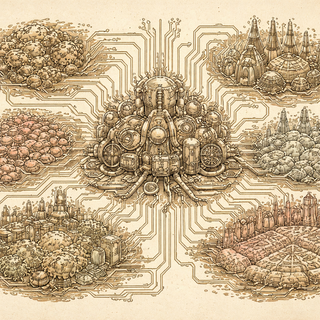
The new Nature study by Zhang and colleagues asks a sneaky question: what if a tumor is less like a lump of rogue cells and more like a city with neighborhoods, zoning laws, and some extremely suspicious residents hanging around the edges? The researchers call those neighborhoods spatial ecotypes - recurring cell communities in the tumor microenvironment, or TME, the messy mix of cancer cells, immune cells, fibroblasts, blood vessels, and biochemical drama surrounding the tumor [1]. And yes, cancer research has now reached the point where we are giving neighborhoods names. Honestly, fair.
A lot of cancer testing still works like this: grab a biopsy, look for mutations, maybe count a few biomarkers, and hope the tiny sample represents the whole mess. Sometimes it does. Sometimes it is like judging Manhattan by licking one subway pole.
That is the problem spatial biology has been trying to fix. Techniques such as spatial transcriptomics measure which genes are active while keeping track of where cells sit in tissue, instead of blending everything into one sad molecular smoothie [2,3]. Over the last few years, researchers have shown again and again that location matters. Cells near the tumor edge can behave differently from cells deeper inside. Immune cells packed into one region can predict something very different from the same immune cells marooned elsewhere [4,5].
Zhang et al. push that idea further. They integrated more than 10 million single-cell and spatial transcriptomic profiles across multiple carcinomas and melanomas, then used machine learning to identify nine conserved spatial ecotypes [1]. Each ecotype had its own biology, geography, and link to clinical outcomes. Some were associated with better survival. Some lined up with resistance to immunotherapy. Same tumor, different neighborhood, different mood.
If you need a mental picture, this is the kind of thing you would sketch in mapb2.io: islands of cell types, traffic patterns between them, and a big note saying "turns out the map matters."
The Part That Makes You Raise an Eyebrow
Here is the flashy bit: the team did not stop at tissue slides. They asked whether these spatial ecotypes could be detected non-invasively through cell-free DNA in blood.
That sounds slightly illegal, like finding out what happened at a house party by sniffing the recycling bin. But biologically, it makes sense. Tumors shed DNA into blood, and that DNA carries methylation patterns - chemical tags on DNA that often track cell identity and gene regulation [1]. The authors trained a deep-learning system, called Liquid EcoTyper, to infer spatial ecotype levels from plasma cfDNA methylomes.
In nearly 100 melanoma patients, those blood-derived ecotype signals showed strong associations with response to immune checkpoint inhibitors [1]. That is the "wait, really?" moment. Not just "tumor DNA is present," which we already knew, but "blood might preserve enough epigenetic breadcrumbs to hint at the tumor's internal layout."
If that holds up, it could matter a lot. Biopsies are invasive, sometimes risky, and annoyingly bad at sampling a tumor that changes across space and time. A blood test you can repeat during treatment is a much more practical way to watch the microenvironment shift. On paper, anyway. Reality enjoys paperwork.
Before We Start Throwing Confetti
This paper is strong, but the fine print matters.
First, the nine ecotypes look broadly conserved across several cancers, which is encouraging, but the liquid biopsy validation here is mainly in melanoma [1]. That is not the same as proving this will work equally well in lung, colon, pancreas, or whatever fresh horror the oncology clinic is juggling next Tuesday.
Second, the authors are explicit that current spatial transcriptomics platforms still have tradeoffs between resolution and gene recovery, and that the biological meaning of these ecotypes still needs experimental confirmation [1]. Machine learning can identify patterns beautifully. It cannot tell you, by itself, whether pattern A causes response or is just standing nearby wearing a convincing lab coat.
Third, blood-based methylation biomarkers for immunotherapy are promising, but this space is still young. Other recent melanoma studies have linked cfDNA methylation markers to anti-PD-1 outcomes too, which is reassuring, but not the same as clinical lock-in [6]. A biomarker can look terrific right up until it meets a new patient cohort and starts acting like a weather app that predicts sunshine during a hurricane.
Still, the direction of travel is clear. Reviews from 2023 and 2024 argue that spatial technologies are becoming central to understanding cancer biology and treatment response, precisely because they capture architecture, not just ingredients [3,4]. Recent studies in brain and other tumors echo the same message: who is next to whom matters, and not in a cute sitcom way [4,5].
So the real headline is not "AI reads blood and solves cancer." Please no. The better headline is: AI is helping turn tumors from blobs into ecosystems. That is less cinematic, but much more useful.
And if oncology really is moving from mutation hunting to ecosystem forecasting, this paper looks a lot like the radar screen clearing just enough to show the storm.
References
-
Zhang W, Brown EL, Usmani A, et al. Non-invasive profiling of the tumour microenvironment with spatial ecotypes. Nature. 2026. DOI: 10.1038/s41586-026-10452-4
-
Wikipedia contributors. Spatial transcriptomics. Wikipedia. https://en.wikipedia.org/wiki/Spatial_transcriptomics
-
Walsh LA, Quail DF. Decoding the tumor microenvironment with spatial technologies. Nature Immunology. 2023;24:1982-1993. Nature link: https://www.nature.com/articles/s41590-023-01678-9
-
Combes AJ, Shih AJ, Singh A, et al. Spatial landscapes of cancers: insights and opportunities. Nature Reviews Clinical Oncology. 2024. Nature link: https://www.nature.com/articles/s41571-024-00926-7
-
Heindl A, et al. Tumour evolution and microenvironment interactions in 2D and 3D space. Nature. 2024;634:1178-1186. DOI: 10.1038/s41586-024-08087-4
-
Jesinghaus M, et al. Circulating Cell-Free SHOX2 DNA Methylation Is a Predictive, Prognostic, and Monitoring Biomarker in Adjuvant and Palliative Anti-PD-1-Treated Melanoma. Clinical Chemistry. 2024;70(3):516-527. DOI: 10.1093/clinchem/hvad230
-
Karimi E, Yu MW, Maritan SM, et al. Single-cell spatial immune landscapes of primary and metastatic brain tumours. Nature. 2023;614:555-563. DOI: 10.1038/s41586-022-05680-3
Disclaimer: This blog post is a simplified summary of published research for educational purposes. The accompanying illustration is artistic and does not depict actual model architectures, data, or experimental results. Always refer to the original paper for technical details.